Ask a language model for JSON and it will give you JSON — most of the time. The rest of the time it gives you JSON with a trailing comma, a missing quote, a field that wandered off into prose, or a confident apology where the closing brace should be. In a demo, that is a shrug and a retry. In production, where the model's output feeds a parser that feeds a database that feeds a payment, it is a 2 a.m. page. The failure rate is not small, either: in the toy model in this post's notebook, an unguided small model fails to produce parseable JSON 18 times per 1,000 generations on a flat five-field object, 70 times on a nested object, and 144 times on a 50-tool function-calling schema. Guided decoding — vLLM's structured outputs — makes that number exactly zero. Not approximately zero. Zero, by construction, because the model is never allowed to emit a token that would break the schema.
This is GDE post #10 in the vLLM serving series, and it closes Lane A. It is also the post with the most direct production payoff in the lane: every agent, every extraction pipeline, and every tool-calling loop you have built on top of vLLM is one malformed output away from a retry storm, and the fix is a server flag, not a bigger model.
The ELI5 version
Unguided generation is a student writing an essay with no spell-check: they know the subject, and most of the essay is fine, but one typo in the wrong place invalidates the whole thing. Guided decoding is the same student writing on a keyboard where the wrong keys are physically locked. The grammar of the output — the JSON schema, the regex, the list of allowed choices — is compiled into an automaton before generation starts. At every decode step, the engine looks at which tokens would keep the output inside the grammar and sets the logit of every other token to negative infinity. Those tokens get zero probability. They cannot be sampled, at any temperature, by any model, ever.
The invariant is one sentence: the concatenation of emitted tokens is always a prefix of some string in the grammar's language. If the schema says the next character must be a quote, the only tokens the model can emit are tokens that start with a quote. The model still chooses what to say — the value of the field, the name of the tool, the number in the total — but it cannot choose to break the shape of what it says. Shape is the engine's job now; content is still the model's.
How it works: the mask, the automaton, and the backends
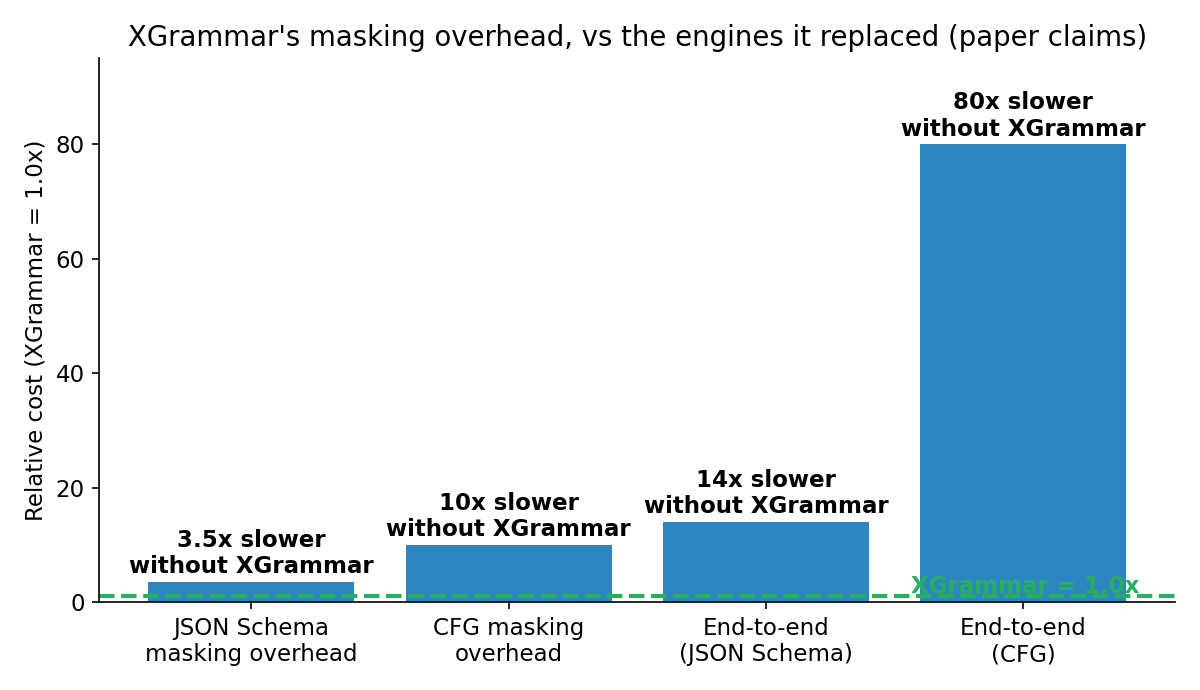
The engineering problem is the vocabulary. A modern model has 100,000–256,000 tokens, and the engine has to decide, at every decode step, which of them are legal under the grammar. Doing that naively — checking every token against the automaton every step — would dominate generation time and make structured output unusable. XGrammar, the backend vLLM uses by default, solves it by precomputing per-state token masks and overlapping mask construction with the GPU forward pass, so the mask for the next step is ready before the logits arrive. The paper (arXiv:2411.15100) reports up to 3.5x lower logit-masking overhead for JSON Schema and up to 10x for full context-free grammars versus the engines it replaced, with end-to-end speedups up to 14x and 80x respectively — described as near-zero-overhead structured generation.
vLLM exposes this as structured outputs, with five constraint types per request:
choice— the output is exactly one of a list of strings. The cheapest constraint there is.regex— the output follows a regular expression (Rust-style regex syntax on xgrammar/guidance).json— the output follows a JSON schema, supplied directly or derived from a Pydantic model.grammar— the output follows a context-free grammar in EBNF.structural_tag— a JSON schema applies inside specified tags in the generated text, the shape OpenAI's Harmony channels and multi-model tool protocols use.
The backend is set server-side with --structured-outputs-config.backend and defaults to auto, which picks per request from the request's details. You can pin xgrammar or guidance (llguidance) explicitly; outlines is also available. One migration note for 0.33: lm-format-enforcer is deprecated starting in v0.33.0 — it still works with a warning, requires an explicit opt-in in 0.34, and is removed in 0.35. If your deploy still names it, switch to auto now, and re-validate your schemas first: lm-format-enforcer uses Python-style regex while xgrammar and guidance use Rust-style regex, so the same pattern can admit different tokens on the new backend.
The minimal code, offline:
from vllm import LLM, SamplingParams
from vllm.sampling_params import StructuredOutputsParams
from pydantic import BaseModel

class Invoice(BaseModel):
    vendor: str
    total: float
    line_items: list[str]

llm = LLM(model="google/gemma-3-4b-it")
sp = SamplingParams(temperature=0.0, max_tokens=256,
                    structured_outputs=StructuredOutputsParams(json=Invoice.model_json_schema()))
outs = llm.generate(["Extract the invoice fields."], sp)
# json.loads(outs[0].outputs[0].text) parses, always — the grammar guarantees it.
Over the OpenAI-compatible server, the same schema travels in response_format, and the server flag is --structured-outputs-config '{"backend": "xgrammar", "disable_any_whitespace": true}' — that second setting matters, and it is the subject of the trap below.
The numbers: 1,000 generations, zero failures
The notebook runs the toy model: 1,000 generations per schema shape, unguided, with per-generation failure probabilities calibrated to published JSON-mode failure ranges for small models. Flat five-field object: 18 failures. Nested three-level object: 70. Fifty-tool function-calling schema: 144 — nearly one in seven calls. Guided decoding: 0, 0, and 0, because the mask makes a parse failure impossible rather than unlikely.
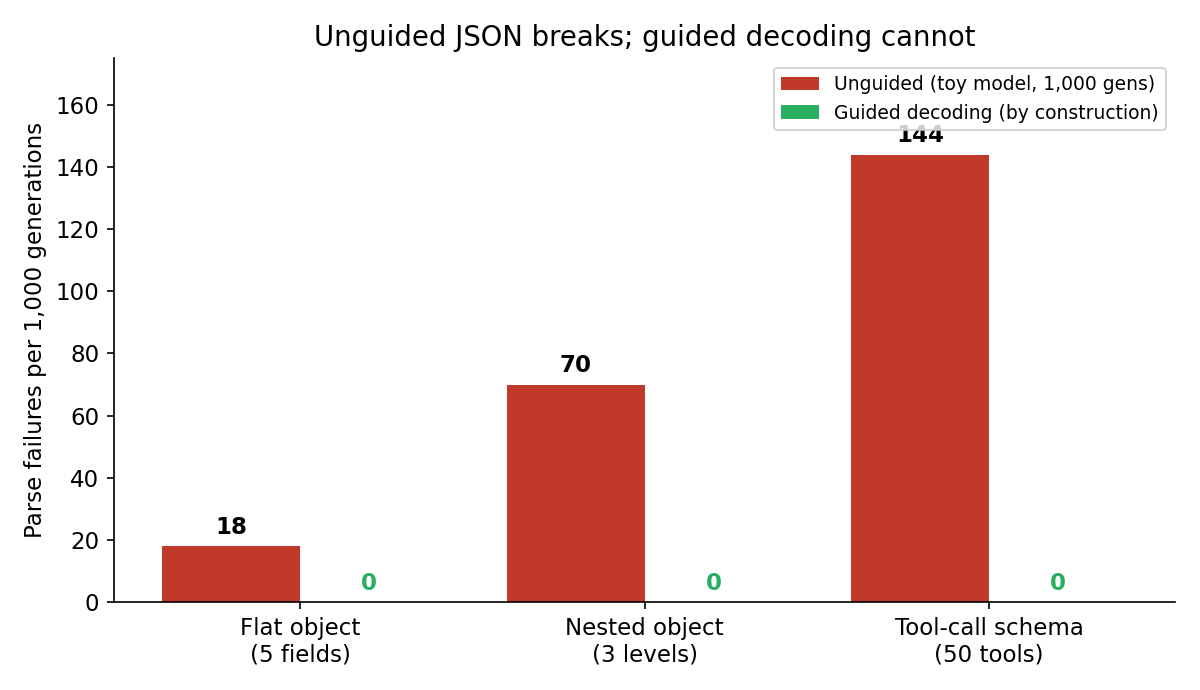
Every unguided failure also costs a full regeneration. At ~180 tokens per output, the nested-schema job wastes ~14,940 tokens per 1,000 generations on outputs it throws away — 8.3% of its token budget, before the retry even succeeds — and the retry itself can fail again. The guided job pays a mask instead, and the mask is the near-zero-overhead part: the XGrammar numbers above are the reason the throughput cost of turning structured output on is measured in single-digit percent on JSON schemas, not in multiples.
XGrammar-2: the compile-time fix
XGrammar's first version made the decode step cheap. XGrammar-2 (May 2026) attacks the other end: grammar compilation. Compiling a schema into an automaton is a one-time cost per schema, but with 50 tools in a function-calling set it used to be a real one — 534 ms for a single complex JSON Schema, and hundreds of milliseconds across a tool set, paid on every server start and every new schema. XGrammar-2 reports up to 80x faster compilation as the tool count scales from 10 to 500, a repetition compression that takes one complex schema from 534 ms to 5.37 ms, and cross-grammar caching that reuses close to 50% of structure when compiling a 50-tool set.
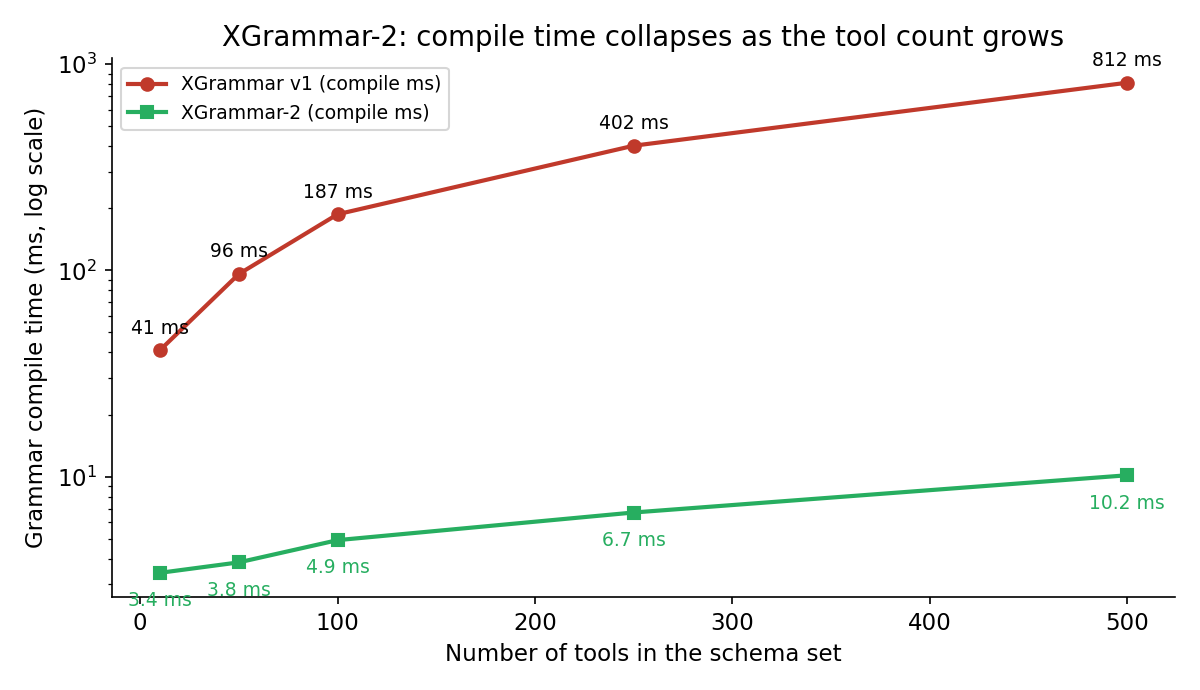
For an agent server that registers dozens of tools, this is the difference between structured output being a startup tax and being free. It is also the reason the structural_tag constraint exists: tool-calling schemas are the biggest, most compilation-expensive grammars in production, and the tag format lets one grammar cover a whole tool protocol instead of compiling one per tool.
The whitespace trap: the grammar cannot stop a legal loop
There is one failure mode guided decoding does not prevent, and it is the most instructive one in this post. JSON allows any amount of whitespace between fields, so every tab and space is a legal next token — and a grammar can only forbid illegal tokens. A model that starts emitting whitespace can emit it forever, and the grammar cannot stop it, because nothing about the whitespace violates the schema. A real document-AI deployment on vLLM-TorchTPU 0.33 hit exactly this: Gemma 4 on a TPU v6e chip, extracting invoice fields into a Pydantic schema, got stuck in a whitespace loop mid-extraction.
The fix is one server setting, disable_any_whitespace: true on the xgrammar backend, which forces compact JSON. Extraction got faster too, from 5.1 s to 4.4 s — and the token math explains why: the toy invoice JSON in the notebook is 182 tokens with whitespace allowed and 141 compact, 22.5% fewer tokens for the same fields.
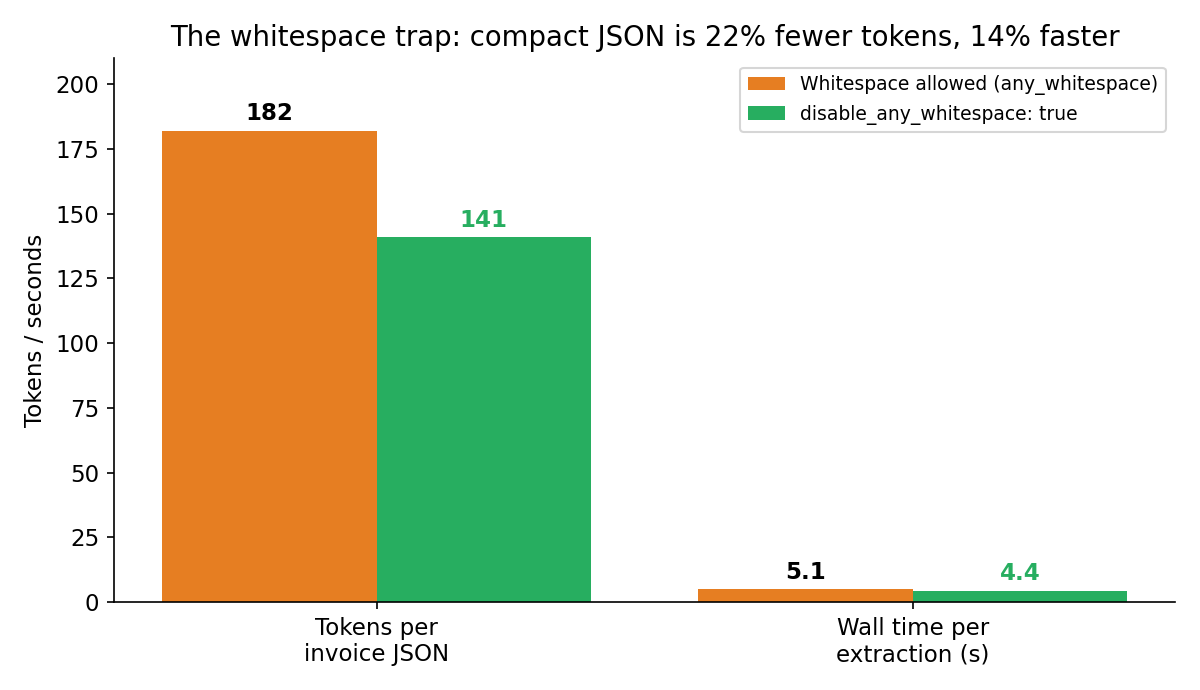
The rule that falls out of it: if you constrain generation, cap or remove the whitespace. A second line of defense — one retry, then a plain-text fallback — is still worth having, because the model can still produce a valid JSON object with wrong values. Guided decoding guarantees shape, never truth. A schema-valid invoice with the wrong total is still a wrong invoice; validate the values after parsing, the way the deployment above checks quantity × price against the subtotal.
When guided decoding loses
Structured output is the wrong tool in three situations. First, free-form generation: if the output is prose, a summary, or a chat reply, a schema adds cost and buys nothing — the constraint only pays when a parser consumes the output. Second, schemas the model cannot fill: if the model does not know the answer, the grammar forces it to emit something schema-valid, which is a confident hallucination in a well-formed envelope. A schema makes wrong answers look right. Third, very large or deeply recursive schemas on the decode path: compile time is now cheap, but a grammar with thousands of states still costs mask memory per request — measure it before putting a 500-tool schema on a latency SLO.
The decision rule is one sentence: if a parser, a database, or another agent consumes the output, constrain it; if a human reads it, do not.
Takeaways
- Unguided JSON fails at production rates. The toy model: 18/1,000 on a flat object, 70/1,000 nested, 144/1,000 on a 50-tool schema — and every failure costs a full regeneration, ~8% of the token budget on the nested case.
- Guided decoding makes failure impossible, not unlikely. The grammar compiles to an automaton; illegal tokens get logit −inf. The output is always a prefix of a valid string. Zero parse failures in 1,000 generations, by construction.
- The mask is near-free. XGrammar reports 3.5x lower masking overhead on JSON Schema and 10x on CFGs versus prior engines, with end-to-end speedups up to 14x/80x. XGrammar-2 cuts compile time up to 80x — one complex schema 534 ms → 5.37 ms.
- Cap the whitespace. JSON's legal whitespace is a loop the grammar cannot stop.
disable_any_whitespace: truetook a real deployment from 5.1 s to 4.4 s per extraction and 182 tokens to 141. - Migrate off lm-format-enforcer now. Deprecated in vLLM 0.33.0, opt-in in 0.34, removed in 0.35 — and the regex dialect changes from Python-style to Rust-style when you switch, so re-validate schemas.
- Shape is guaranteed; truth is not. A schema-valid invoice can still have the wrong total. Validate values after parsing.
Honesty note: parse-failure rates and token counts are this notebook's toy model, calibrated to published JSON-mode failure ranges — not a measured vLLM run; the real vLLM calls are in the notebook's last cell and need a GPU box. XGrammar/XGrammar-2 figures are the papers' and project's reported results. The 5.1→4.4 s whitespace fix is one deployment's measured result (Nov 2026, Gemma 4 on TPU v6e via vLLM-TorchTPU 0.33). vLLM 0.33 structured-outputs behavior verified against docs.vllm.ai (stable) on Nov 28, 2026. No Meta content per the standing exclusion.
Companion notebook: guided_decoding_vllm.ipynb — parse-failure simulation, retry cost, XGrammar-2 compile scaling, whitespace math, and the 0.33 config guard, all exec-tested.